Introduction
In Thailand, the way customers order food is changing rapidly. From the bustling street food stalls of Bangkok to chic cafés in Chiang Mai and luxury resorts in Phuket, self-ordering systems are becoming the new normal. Guests can now scan a QR code, browse a digital menu in multiple languages, customize their order, and pay instantly using PromptPay, e-wallets, or cards—all without waiting for a server. This shift was accelerated during the pandemic and has continued thanks to Thailand’s world-class payment infrastructure, growing digital literacy, and the hospitality sector’s push for efficiency. For restaurants, cafés, and hotels, adopting a ระบบสั่งออเดอร์สินค้าด้วยตนเอง offers faster service, fewer mistakes, stronger upselling opportunities, and lower staffing costs. But success requires more than just QR codes—it means designing user-friendly experiences, staying compliant with Thai tax and privacy laws, and balancing technology with Thai-style hospitality. This guide explores how to do it right.
Why Thailand is Ready for Self-Ordering
-
PromptPay and QR familiarity: Thai diners already trust QR codes for payments, making digital menus feel natural.
-
Labor cost pressures: Restaurants need to do more with leaner teams, and automation helps.
-
Tourism rebound: Millions of visitors expect quick, multilingual ordering options.
-
POS integration growth: Thai platforms like Wongnai FoodStory now offer seamless ordering, payment, and reporting.
These conditions make Thailand one of the best markets in Southeast Asia for contactless ordering systems.
What a Self-Ordering System Looks Like
-
Table QR codes (สแกนคิวอาร์ที่โต๊ะ): Diners scan a code to view the menu, add items, split bills, and pay instantly.
-
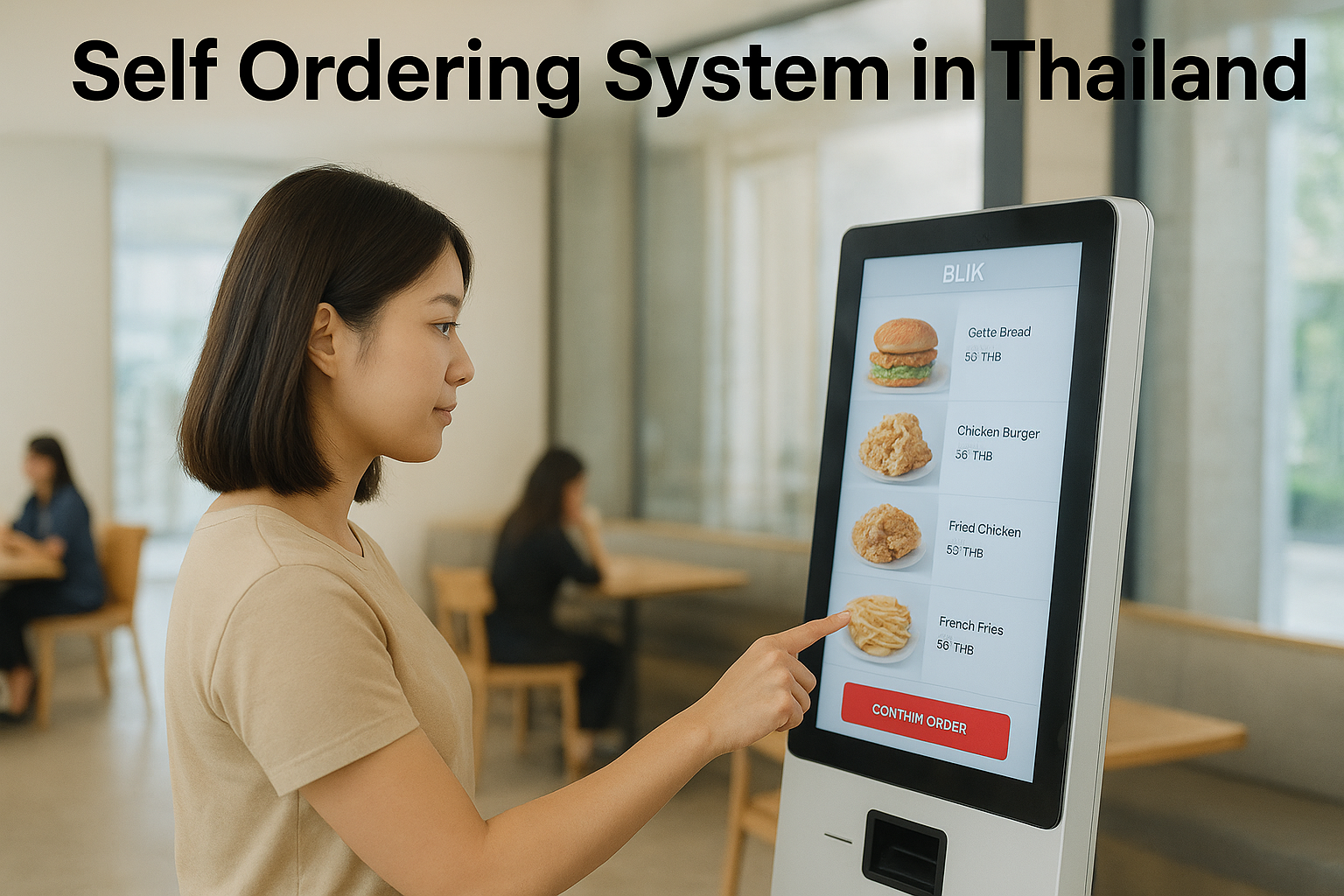
Self-order kiosks (ตู้คีออส): Large touchscreens, often in fast food or malls, allow guests to order and pay without staff.
-
Hybrid models: Staff still welcome guests, explain dishes, and deliver food, while customers use digital ordering for convenience.
Benefits for Thai Restaurants
-
Faster table turnover: Guests can order as soon as they’re ready.
-
Fewer errors: Digital modifiers (spice level, no coriander, rice type) reduce mistakes.
-
Higher average order value: Upsell prompts (“add fried egg,” “make it a set”) appear consistently.
-
Instant payments: PromptPay QR gives immediate confirmation to the POS.
-
Multilingual menus: Supports Thai, English, Chinese, and Korean for tourists.
Common Challenges and How to Solve Them
-
Poor UX design: Complicated flows frustrate diners. Keep ordering within three taps.
-
Connectivity issues: Optimize menus for low-bandwidth networks.
-
Elderly or non-digital guests: Provide backup paper menus and staff assistance.
-
Loss of hospitality: Balance tech with human interaction—staff should still check in and engage.
Compliance Essentials in Thailand
-
PDPA (Personal Data Protection Act): If collecting names or phone numbers, restaurants must show a clear privacy notice, collect consent where needed, and allow customers to request data deletion.
-
VAT requirements: Restaurants must display VAT clearly. Thailand currently applies 7% VAT, shown in receipts and checkout.
-
Secure payments: Use HTTPS, encrypt data, and work with reputable payment providers.
-
E-receipts: Provide bilingual receipts with tax ID, VAT breakdown, and timestamp.
Vendor Landscape in Thailand
-
Wongnai FoodStory: Offers POS + self-order integration with PromptPay.
-
Global providers: Many support QR menus, kiosks, and Thai payment methods.
-
Build-your-own: Larger chains with IT teams may choose to develop custom apps, but most SMEs benefit from buying ready-made systems.
How to Roll Out a Self-Ordering System
-
Design guest journey: From greeting → scan → browse → order → pay.
-
Menu optimization: Highlight best-sellers, combos, and tourist favorites.
-
Enable payments: PromptPay QR, wallets, cards, and split bill options.
-
Set up hardware: Durable QR table tents, kiosks, kitchen display systems.
-
Train staff: Teach how to assist guests and ensure smooth adoption.
-
Pilot test: Start with a few tables, refine, then scale.
-
Promote usage: Offer small incentives for first-time digital orders.
KPIs to Track
-
Time from seating to first order
-
Average order value (AOV)
-
Payment failure rate
-
Order accuracy vs. manual entry
-
Table turnover time
-
Guest satisfaction (ratings/NPS)
UX Best Practices for Thai Diners
-
No forced app downloads—menus should open instantly in the browser.
-
Multilingual toggle available at every step.
-
Allergen and spice-level indicators.
-
Clear VAT and service charge breakdown before payment.
-
Accessible design with large fonts and high-contrast menus.
Marketing Through Self-Ordering
-
Localized upsells: “Add Thai milk tea” or “Pair with sticky rice.”
-
Tourist promotions: Bundled sets for groups or family deals.
-
Storytelling: Highlight the origin of dishes like Isan favorites or Northern specialties.
-
Feedback prompts: One-tap ratings help improve menus.
-
Loyalty rewards: Digital stamp cards with consent for marketing.
Cost and ROI Considerations
-
Software fees: Monthly POS and ordering module subscription.
-
Hardware costs: Kiosks, printers, tablets, QR table tags.
-
Payment costs: PromptPay is very low fee; card payments carry merchant discount rates.
-
Savings and growth: Lower labor needs, fewer order errors, faster table turnover, and stronger upsells balance costs.
Pre-Launch Checklist for Thai Operators
-
Multilingual menus ready (TH/EN/中文).
-
PromptPay QR tested in real-world settings.
-
VAT and service charges displayed clearly.
-
Privacy policy aligned with PDPA.
-
Backup paper menus available.
-
Offline ordering fallback.
-
Accessible kiosk design.
-
Staff trained to assist.
-
Kitchen routing tested.
-
Metrics dashboard set up.
Read More: Techsslaash.com Review: Features, Issues, and Alternatives
Conclusion
Thailand’s hospitality industry thrives on a balance of warmth and efficiency. A well-designed self-ordering system (ระบบสั่งออเดอร์สินค้าด้วยตนเอง) can amplify both, making dining smoother for guests and operations smarter for restaurants. By combining QR menus, PromptPay payments, and multilingual support with friendly staff service, venues can serve locals and tourists with equal ease. The key lies in execution: simple flows, transparent pricing, PDPA compliance, and seamless POS integration. Done right, self-ordering not only saves time and reduces errors but also unlocks new upselling opportunities and valuable customer insights. For operators, this is not just about keeping up with trends—it’s about staying competitive in a fast-evolving dining landscape. In 2025, self-ordering isn’t replacing Thai hospitality—it’s enhancing it, ensuring every guest can enjoy the flavors of Thailand with speed, clarity, and care.
FAQs
Q1. How does a self-ordering system work in Thailand?
Guests scan a QR code or use a kiosk to browse a digital menu, place orders, and pay via PromptPay or cards, while staff still assist and deliver food.
Q2. Is PromptPay safe for restaurant payments?
Yes. PromptPay is Thailand’s official real-time payment system, widely trusted and secure, with instant confirmation for both customers and restaurants.
Q3. Do restaurants still need printed menus?
Yes. While QR menus are popular, printed menus remain essential for elderly guests, areas with weak internet, or customers who prefer traditional ordering.
Q4. How should Thai restaurants handle VAT?
Restaurants should clearly display 7% VAT and any service charges in the digital checkout process and issue receipts with VAT breakdowns.
Q5. What data privacy laws apply to self-ordering systems in Thailand?
The Personal Data Protection Act (PDPA) requires restaurants to inform guests about data use, collect consent for marketing, protect personal data, and honor deletion requests.
1 thought on “Self-Ordering System in Thailand: The Complete 2025 Guide (ระบบสั่งออเดอร์สินค้าด้วยตนเองในประเทศไทย)”